

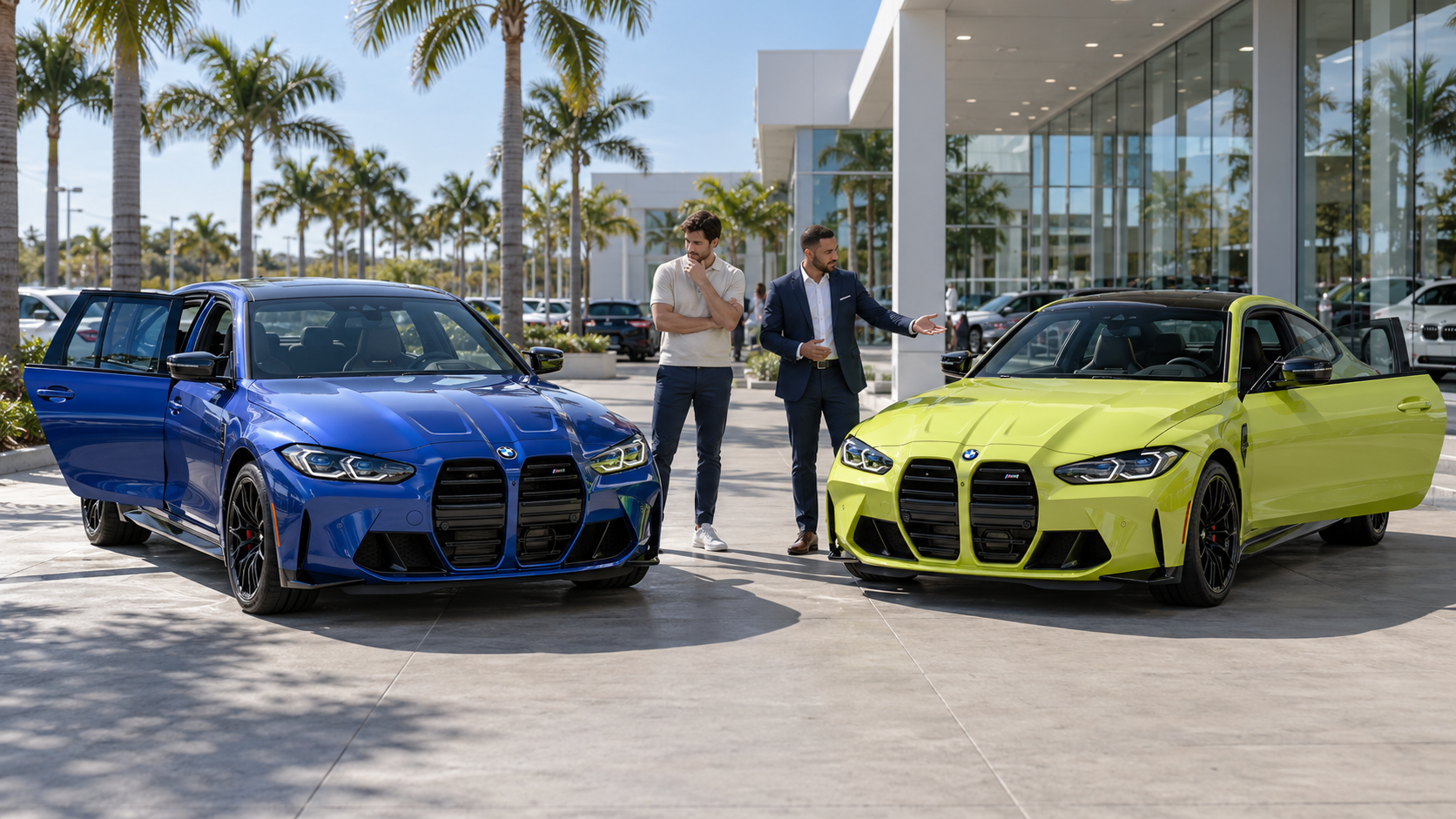
BMW M3 vs M4 shoppers are choosing between a four door sedan and a two door coupe. Both models share closely related engines, trim structures, and drivetrain choices. Therefore, the body layout becomes one of the clearest decision points. The M3 gives rear passengers their own doors. The M4 uses longer front doors and requires rear passengers to enter from the front. As a result, that difference shapes passenger access, parking routines, and cabin entry throughout the week.
What Separates the BMW M3 From the BMW M4?
What separates the BMW M3 from the BMW M4? The M3 is a four door sedan, while the M4 is a two door coupe. Both use BMW M TwinPower Turbo inline six engines across the current range. Therefore, equivalent trims share more mechanical similarities than their exterior shapes suggest.
The base M3 and base M4 each use rear wheel drive with a six speed manual transmission. Their Competition versions move to an eight speed automatic transmission. In addition, Competition xDrive versions add BMW M xDrive with the same automatic gearbox.
Because the core trim structure overlaps, body format deserves close attention early. The M3 places function around four side doors and direct rear seat entry. The M4 uses two longer doors and a coupe roofline. Therefore, the shopper is choosing how people enter the cabin as much as how the car looks.
A test drive should begin with the same trim level in each model when possible. That keeps the comparison focused on body shape, seating access, visibility, and cabin entry.
Rear Seat Access Changes the Routine
Rear seat access creates one of the clearest differences between these cars. The M3 gives rear passengers a separate door on each side. Therefore, passengers can enter without moving either front seat.
The M4 uses the front doors for rear entry. A front seat must move forward before someone can step into the rear area. That process can feel simple during occasional trips. However, it becomes a repeated task when rear passengers travel with you several times each week.
Think about who uses the back seats and how frequently they ride.
- The M3 makes repeated rear entry easier because each rear passenger has a dedicated door.
- The M4 keeps rear seating available, but access requires movement through the larger front door opening.
- Child seat access deserves an in person check because door count changes how you reach the rear bench.
Door length also matters in parking lots. Coupe doors need more side clearance when they open wide. By contrast, four shorter doors can make entry easier in tighter spaces. Therefore, parking habits belong in the body style decision.
In addition, the rear seat itself should be tested before purchase. Sit behind your normal front seat position and check headroom, knee room, and entry effort. That gives a clearer answer than seat count alone.
Cargo Space Should Be Judged Separately
Coupe styling does not remove useful trunk space from the M4. BMW lists up to 15.5 cubic feet of cargo volume for the current M4 Coupe. Therefore, luggage and everyday cargo remain part of the car's usable layout.
The M3 also gives shoppers a conventional rear trunk. However, cargo needs should be judged separately from rear passenger access. A shopper may rarely use the rear seats yet carry bags or work gear every day. Another may carry people far more frequently than large cargo.
Before deciding, test the trunk with the items you use most.
- Bring a stroller, golf bag, luggage, or work case if one of those items travels with you regularly.
- Check the trunk opening as well as the listed volume because shape can change how larger items fit.
- Fold the rear seatbacks when available to see how longer cargo changes the cabin setup.
Moreover, the sedan and coupe both support normal trunk use, but their passenger layouts remain different. Therefore, cargo alone should not decide between them.
For Orange Park and Jacksonville trips, think about airport luggage, grocery runs, sports gear, and weekend bags. Those items reveal whether the trunk opening and rear seat folding layout work for your routine.
Manual Automatic Rear Drive and xDrive Choices
Transmission choice deserves a separate review because it changes with trim. Can you get a manual M3 or M4? Yes, the base M3 and base M4 each retain a six speed manual transmission.
Those base versions pair the manual with rear wheel drive. Therefore, shoppers who want three pedals begin with the standard M3 or M4 configuration. The Competition models use an eight speed automatic transmission instead.
Current Competition xDrive versions add BMW M xDrive. They also keep the eight speed automatic. Therefore, the current range does not pair the manual transmission with M xDrive.
The engine family stays closely related across the two body styles. Equivalent M3 and M4 trims also carry matching output figures. For this reason, the larger choice remains body format and drivetrain configuration.
Ask yourself whether shifting manually is a priority. Then decide whether rear wheel drive or M xDrive fits your plans better. After that, compare the M3 and M4 within the matching trim.
That order keeps transmission choice from becoming mixed with the sedan versus coupe question.
Which Body Style Fits Your Daily Routine?
Which body style fits your daily routine? Choose based on how regularly you use the rear seats, passenger doors, and cargo area. The M3 suits drivers who want direct rear access without giving up the current M drivetrain choices. The M4 suits shoppers who prefer a two door coupe and use rear entry less frequently.
Next, compare your preferred transmission and drivetrain. If the manual matters most, start with the base M3 and M4. If M xDrive matters more, focus on the Competition xDrive versions.
Then review current inventory at Tom Bush BMW Orange Park. Therefore, a live inventory check can show which trims, colors, interiors, and packages are available locally. In addition, a test drive can reveal door reach, seating access, visibility, and parking fit.
Do not choose from specifications alone. Open every door, sit in the rear seat, load the trunk, and drive the trim you are considering. Those simple checks turn the M3 and M4 comparison into a decision based on your own routine.
Tom Bush BMW Orange Park offers current M3 and M4 inventory for side by side comparison. From there, you can choose the body style and drivetrain combination that fits how you plan to use the car.