


Modern vehicles are increasingly defined by how drivers interact with technology inside the cabin. For BMW, the digital cockpit is not simply a place to display navigation or media information. It functions as a central interface that connects vehicle systems, driver information, and connected services into one integrated environment.
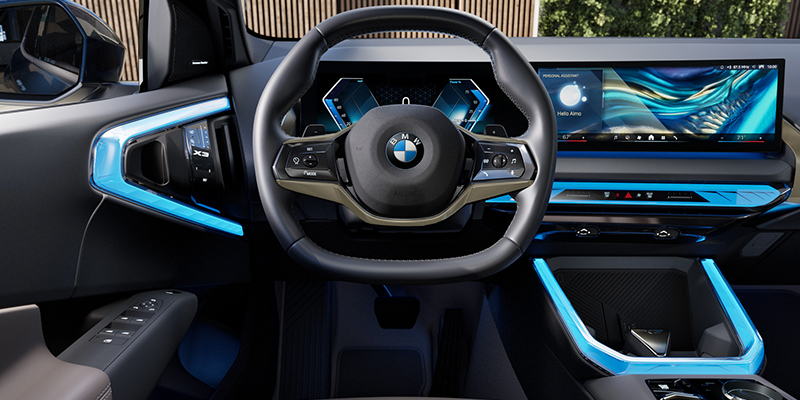
Shoppers researching BMW vehicles often notice the BMW Curved Display, a distinctive panoramic screen that stretches across the dashboard. While the visual design stands out immediately, the real purpose of the system is to organize critical driving information in a way that keeps drivers informed while maintaining focus on the road. Understanding how the BMW digital cockpit works helps explain why it has become a defining feature across the BMW lineup.
How the BMW Curved Display Organizes Driver Information
Many shoppers ask what the BMW Curved Display actually does beyond replacing traditional gauges. The BMW Curved Display is a panoramic digital interface that combines the instrument cluster and infotainment screen into a single driver oriented display system.
In BMW vehicles equipped with this technology, the display is divided into two functional areas. The portion directly in front of the driver acts as the digital instrument cluster, while the center portion serves as the primary infotainment and control interface.
This layout allows drivers to access several types of information simultaneously:
- Vehicle speed and driving data
- Navigation guidance and route information
- Media and audio controls
- Vehicle status and driver assistance alerts
- Connected services and communication features
The curved orientation of the display is designed to angle information toward the driver. Instead of placing screens flat across the dashboard, BMW positions the interface so that key driving information remains within the driver’s natural line of sight.
How the BMW iDrive System Powers the Digital Cockpit
The visual display is only one part of the BMW cockpit system. Behind the interface is BMW iDrive, the operating system that manages infotainment, vehicle settings, and connected features.
BMW iDrive organizes the vehicle’s technology into several primary functions that drivers can access through the central interface.
These include:
- Navigation and route guidance
- Media streaming and audio control
- Climate system adjustments
- Vehicle configuration settings
- Driver assistance system monitoring
The BMW iDrive interface is designed to simplify access to these systems through clear menus and customizable layouts. Drivers can arrange frequently used features so they appear quickly within the display.
Instead of relying on a single control method, BMW provides multiple ways to interact with the system. Drivers can use touch inputs on the screen, steering wheel controls, voice commands, or the center console controller depending on preference.
How the BMW Digital Instrument Cluster Supports Driving Awareness
The BMW digital instrument cluster replaces traditional analog gauges with a dynamic display capable of presenting multiple layers of information.
Many drivers wonder what information appears on the BMW digital cluster and how it changes during driving. The display adjusts based on vehicle activity, navigation guidance, and driver assistance systems.
For example, the BMW digital instrument cluster can display:
- Current speed and driving mode
- Navigation directions integrated directly into the gauge display
- Adaptive cruise control distance indicators
- Lane guidance from driver assistance systems
- Fuel or energy consumption data
Because the system is digital, the layout can change depending on the selected driving mode. Sport oriented modes may emphasize performance data, while comfort oriented modes may prioritize navigation and efficiency information.
This adaptability allows drivers to see the most relevant information without switching between screens or menus.
Voice Control and Connected Technology Inside the BMW Cockpit
Interacting with vehicle technology should not require drivers to take their attention away from driving. For this reason, BMW integrates voice control and connected technology directly into the digital cockpit system.
BMW voice commands allow drivers to access several functions without touching the display. Drivers can request navigation destinations, adjust climate settings, or change media playback through natural language prompts.
Connected services extend the functionality of the cockpit beyond the vehicle itself. Drivers can access real time traffic updates, remote vehicle services, and integrated smartphone connectivity.
These features allow the BMW cockpit to act as a digital hub that connects the driver, the vehicle, and external information sources.
How the BMW Digital Cockpit Improves the Overall Driving Experience
Technology inside a vehicle should enhance the driving experience rather than distract from it. BMW approaches cockpit design with the goal of keeping the driver informed while minimizing unnecessary complexity.
The BMW Curved Display and digital cockpit architecture contribute to the driving experience in several ways:
- Important driving information remains directly in front of the driver
- Navigation guidance is easier to follow when integrated with the instrument cluster
- Multiple interaction methods allow drivers to choose the most convenient control method
- Vehicle systems can be monitored through a centralized interface
For shoppers comparing vehicles in the luxury sedan or SUV segments, the digital cockpit has become an important part of the ownership experience. BMW’s approach focuses on integrating technology with driver awareness rather than overwhelming the driver with disconnected screens or controls.
As vehicles continue to incorporate more advanced systems and connected features, the BMW digital cockpit demonstrates how thoughtful interface design can support both convenience and driving focus.
Connect with us


