


Florida SunCoast BMW CCA connects regional BMW enthusiasts through chapter information, social gatherings, and shared owner activities. It is an official chapter of the BMW Car Club of America. Therefore, Orange Park owners can use its calendar to find Jacksonville area meetings, drives, and social events.
The chapter and Tom Bush BMW Orange Park are separate organizations. The dealership does not enroll members or manage the club calendar. Instead, owners should confirm membership and event details through official BMW CCA and chapter resources.
What Is the Florida SunCoast BMW CCA?
The Florida SunCoast BMW CCA is a regional chapter of the BMW Car Club of America. BMW CCA supports local chapters across the country. Each chapter creates opportunities for members to meet, learn, and share their interest in BMW cars.
The Florida SunCoast chapter serves members across a wide area of Florida. Moreover, its website organizes event information by location, including Jacksonville. That local category makes the chapter relevant for owners near Orange Park and neighboring communities.
Read the rest of this entry »BMW Ignition Coil Symptoms Causes and Service Steps
BMW ignition coil symptoms can include rough idle, hesitation, starting trouble, reduced power, and a check engine light. However, these signs do not confirm a failed coil without testing. A spark plug, injector, wiring fault, air leak, or compression issue can create similar engine responses.
For this reason, owners should focus on when each sign appears and how the engine responds. Those details give a BMW technician useful direction during diagnosis. They also reduce the chance of replacing a part that did not cause the concern.
What Does a BMW Ignition Coil Do?
A BMW ignition coil raises battery voltage so the spark plug can ignite the air and fuel mixture. Each combustion event needs a strong spark at the correct moment.
The battery supplies low voltage electrical power. However, the spark plug needs far greater voltage to bridge its electrode gap. The ignition coil transforms that lower input into the stronger output needed for ignition.
On many BMW engines, one coil sits above each spark plug. Therefore, one weak coil may interrupt combustion in one cylinder while the remaining cylinders continue firing.
Read the rest of this entry »BMW EfficientDynamics brings together BMW features that manage energy use, driving feedback, and selected vehicle responses. For this reason, the name can appear within the instrument cluster, control display, feature list, or owner information. However, it does not describe one single button or part.
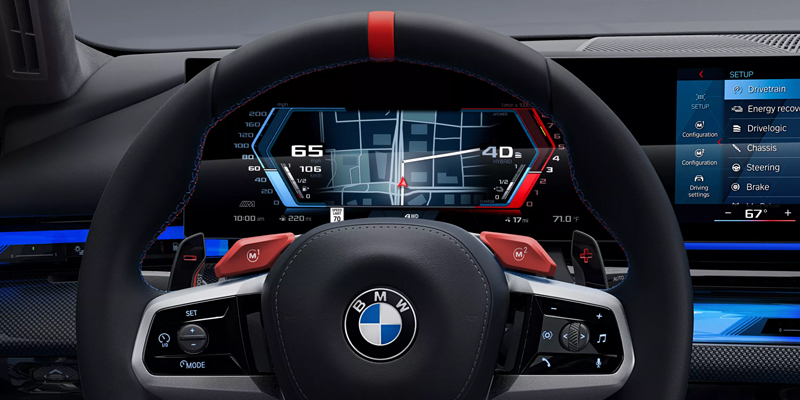
Additionally, some BMW models use ECO PRO, while newer interfaces may show Efficient Mode. Each version can pair driving guidance with settings that reduce fuel or electrical demand. However, available functions vary by model year, drivetrain, equipment, and software.
With that in mind, Orange Park drivers can read each graphic by learning its purpose. Stop and go traffic, highway travel, and strong air conditioning demand can each change the information shown.
What Does BMW EfficientDynamics Mean?
BMW EfficientDynamics is BMW terminology for a group of energy saving features and engineering measures. These measures can include drive mode settings, coasting, Auto Start Stop, aerodynamic work, and energy recovery.
Therefore, the goal is to reduce wasted energy while keeping the BMW ready for normal road travel. However, a gasoline model may use different features than a plug in hybrid or electric BMW.
Beyond that, BMW EfficientDynamics can describe design choices that are not visible from the driver seat. Air flow work, lighter materials, and engine management can contribute without adding another menu or icon.
Read the rest of this entry »BMW lease specials are built around two financial variables most shoppers never see: residual value and money factor. The monthly payment a dealer presents is the result of those two numbers working together. Understanding what each one does, how a promotional special changes them, and what mileage selection does to the math gives you the tools to evaluate any BMW lease offer accurately. A low monthly payment is not always a strong deal. A strong deal requires both variables working in your favor.
What Residual Value Does to Your Monthly Payment
Residual value is the projected worth of the vehicle at lease end. BMW Financial Services expresses it as a percentage of the original MSRP. A vehicle with a 55% residual on a $50,000 MSRP carries a projected end value of $27,500. The depreciation portion of your monthly payment covers the gap between the capitalized cost and that residual figure, spread across the lease term.
A higher residual percentage means less depreciation to finance. Less depreciation produces a lower base payment. This is why certain BMW models lease more favorably than others. A model that holds its value well carries a stronger residual. That directly reduces what you pay each month. A model with a weaker residual forces you to finance a larger depreciation amount regardless of the selling price negotiated at signing.
BMW lease specials frequently involve a subsidized residual. BMW Financial Services raises the residual percentage above its standard projected value to reduce depreciation and lower the payment. That subsidy is not reflected in the vehicle’s actual market value. It is a promotional tool. Confirming the residual percentage on any lease special tells you how much of the payment reduction came from BMW’s subsidy versus a negotiated selling price.
Read the rest of this entry »BMW Brake Pad Replacement: Signs and Service Timing
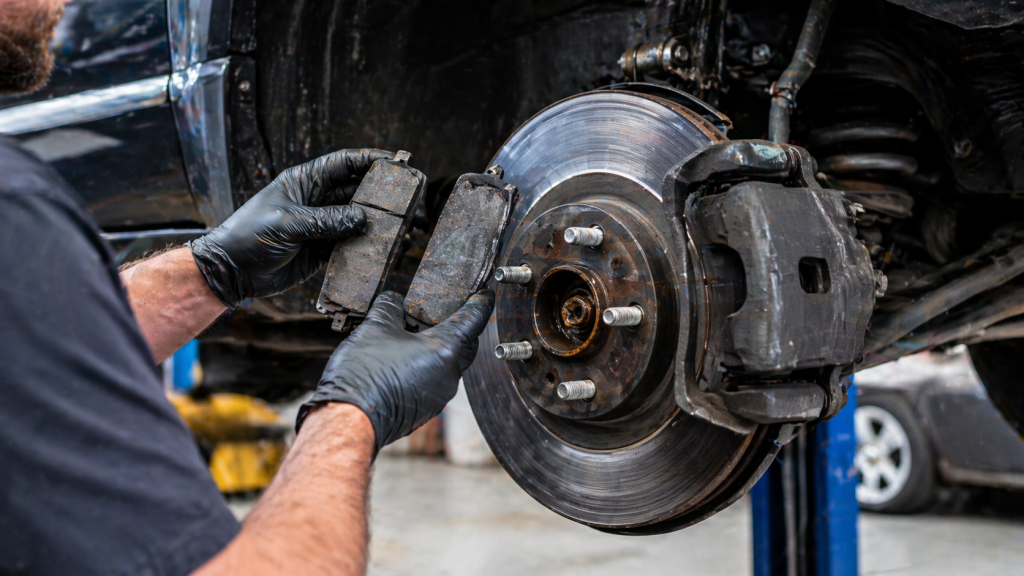
BMW brake pad replacement is one of the most common service decisions an owner faces, and knowing when to act makes the difference between a routine pad swap and a costlier brake system repair. BMW uses an electronic wear sensor system that alerts the driver at a specific pad thickness threshold. However, that warning light is not the only signal worth monitoring. Understanding how the sensor works, what physical signs precede it, and what a complete brake evaluation involves gives you a more accurate picture of where your brake system actually stands.
How BMW Brake Wear Sensors Work
BMW embeds electronic brake wear sensors directly into the brake pad material. Each sensor contains a resistive wire that maintains a closed electrical circuit while pad material surrounds it. As the pad wears to approximately 2 to 3mm of remaining thickness, the rotor contacts the wire and breaks that circuit. That interruption triggers the brake pad warning indicator on the instrument cluster.
The sensor is a single-use component. Once the rotor severs the wire, the sensor cannot be reset or reused. A technician must replace it alongside the pad at every service. BMW typically installs sensors on the front inner pads and one rear pad. These positions wear fastest and generate the most reliable wear data across the axle. However, a rear sensor alert confirms the rear pads have reached threshold. It does not confirm the front pads are in good condition.
Read the rest of this entry »The BMW maintenance plan that comes with every new vehicle is called Ultimate Care, and it covers factory-scheduled services for the first 3 years or 36,000 miles. Most shoppers know the name but not the mechanics behind it. Understanding how the program is structured, what the Condition Based Service system does, and how Ultimate Care differs from Ultimate Care+ gives you a clearer picture of what you are actually getting. Moreover, knowing what decisions must be made before you leave the dealership protects you from missing options that cannot be added later.
How BMW Ultimate Care Works and What It Covers
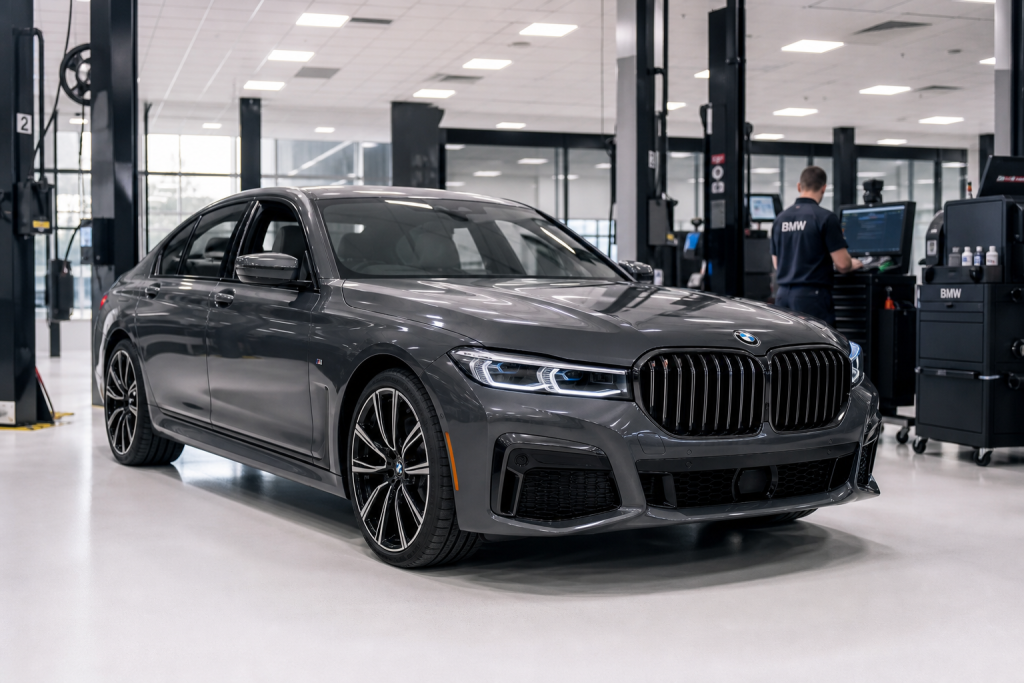
Every new BMW includes Ultimate Care at no additional cost. The program covers all factory-scheduled maintenance services for the duration of the coverage window. That includes engine oil and filter changes, brake fluid service, vehicle check services, and remote software updates where applicable. All covered services must be performed at an authorized BMW center using BMW-approved parts and fluids.
The coverage window closes at whichever limit arrives first: 3 years or 36,000 miles. A driver who reaches 36,000 miles in 18 months exhausts the program at that point. A driver who keeps annual mileage low will hit the 3-year calendar limit before reaching the mileage cap. Knowing which boundary applies to your driving pattern matters because it shapes how much remaining coverage you carry into any extension decision.
BMW does not trigger services through fixed mileage intervals under this program. Instead, the Condition Based Service system monitors vehicle data continuously and calculates when each service is actually needed. This is why two owners driving identical models can receive oil change alerts at different mileage points. The interval reflects actual vehicle state, not a number on a sticker.
Condition Based Service: The System Behind the Schedule
Condition Based Service is a sensor-driven monitoring system built into every BMW. It tracks multiple vehicle parameters simultaneously, including engine oil quality, brake fluid moisture content, air filter load, and microfilter condition. Each parameter feeds into a separate service counter that calculates remaining life as a percentage. Additionally, the system alerts the driver when a threshold approaches so service can be scheduled before a condition deteriorates.
How CBS Calculates Oil Life
Oil life calculation under CBS goes beyond simple mileage counting. The system evaluates oil temperature cycles, engine load history, cold start frequency, and short-trip accumulation. A vehicle used primarily for highway driving at steady throttle will carry healthier oil longer than one used for repeated short urban trips, even at identical mileage. As a result, CBS-driven oil change intervals on BMWs frequently extend beyond 10,000 miles and can reach up to 15,000 miles under favorable conditions.
How CBS Monitors Brake Fluid
Brake fluid monitoring works differently from oil tracking. CBS measures the moisture absorption level of the fluid rather than mileage or calendar date alone. Brake fluid absorbs water through the hydraulic system, which lowers its boiling point and reduces stopping reliability under heavy use. When CBS detects that moisture content crosses a threshold, it flags a brake fluid service regardless of mileage traveled. This approach reflects how BMW calibrates service needs to actual vehicle state rather than fixed-schedule assumptions.
Ultimate Care vs. Ultimate Care+: What Actually Separates Them
BMW includes Ultimate Care with every new vehicle purchase, requiring no decision at the point of sale. Ultimate Care+ is a separate, optional program that extends and expands coverage beyond the base plan. However, a buyer must purchase Ultimate Care+ at the time of vehicle acquisition. After taking delivery without adding it, that window closes permanently.
The most significant coverage difference between the two programs is wear-and-tear item inclusion. Base Ultimate Care covers scheduled maintenance services only. Ultimate Care+, by contrast, adds coverage for items that wear through normal use, including front and rear brake pads, brake discs, wiper blade inserts, belts, and clutch linings on manual transmission vehicles. BMW’s new vehicle limited warranty does not cover these items. They are, however, among the most common service costs an owner encounters in years two through five of ownership.
Ultimate Care+ runs across four extension tiers, each defined by a cumulative mileage window that begins where base Ultimate Care ends:
- Ultimate Care+1 extends coverage an additional 12 months, adding wear-and-tear item coverage alongside continued scheduled maintenance up to 14,000 miles beyond the base plan endpoint
- Ultimate Care+2 covers 24 months and extends the program to 39,000 miles beyond base coverage, including both scheduled maintenance and wear-and-tear items throughout
- Ultimate Care+3 runs 36 months and extends to 64,000 miles beyond the base endpoint, maintaining the same dual coverage structure across a longer ownership window
- Ultimate Care+4 provides the broadest extension at 48 months, covering scheduled maintenance and wear-and-tear items to 89,000 miles beyond where base Ultimate Care concludes
The right tier depends on expected ownership length and annual mileage. A driver who keeps vehicles for five or six years and covers 15,000 miles annually will exhaust base Ultimate Care early. Without an extension, several years of out-of-pocket service costs follow.
What Does Ultimate Care Actually Exclude?
Understanding what the program does not cover is as important as knowing what it does. Base Ultimate Care is a scheduled maintenance program, not a comprehensive service contract. BMW schedules what it covers. Wear, breakage, and consumption outside those scheduled intervals fall to the owner.
Tires are excluded from both Ultimate Care and Ultimate Care+. Tire wear varies too significantly based on driving habits, road surface, and load to incorporate into a fixed program structure. Batteries also fall outside coverage, including both the main drive battery on electric models and the 12-volt auxiliary battery on all vehicles. Furthermore, fluid top-offs between scheduled services, including coolant, windshield washer fluid, and power steering fluid, are excluded entirely.
- Tires, wheels, and wheel alignments are not covered under any tier of Ultimate Care or Ultimate Care+, and BMW treats tire wear as an owner-managed consumable cost
- The 12-volt auxiliary battery and, on electric models, the high-voltage drive battery fall outside program coverage regardless of which Ultimate Care tier is active
- Fluid top-offs between scheduled service intervals are the owner’s responsibility and BMW does not reimburse them under either the base program or any Ultimate Care+ extension
Damage from accidents, misuse, or environmental factors also falls outside the scope of this program. BMW’s new vehicle limited warranty addresses manufacturing defects. Auto insurance covers external damage. Shoppers who understand the boundary between scheduled maintenance, wear-and-tear coverage, and warranty protection can evaluate each layer of their BMW’s coverage accurately.
Is Extending Your Coverage Worth It?
The value calculation for Ultimate Care+ comes down to two numbers: what the extension costs at acquisition and what covered services would cost out of pocket at an authorized BMW center. A single brake pad and disc service on a BMW can run between $400 and $700 per axle depending on the model. Brake fluid service typically runs $150 to $250. Furthermore, an oil and filter service at a BMW dealer averages $150 to $200 per visit.
Drivers who keep their vehicles beyond 36,000 miles and plan to use authorized BMW service will face those costs without an extension. Ultimate Care+ consolidates them into a single prepaid amount at acquisition. It also locks in current labor and parts pricing rather than paying rates that may increase across the ownership period. For higher-mileage drivers, that math frequently favors the extension. For drivers who trade vehicles before 50,000 miles, the decision is tighter and depends on which wear-and-tear items would realistically be needed within that window.
Transferability is also worth evaluating at the point of purchase. For BMW vehicles from the 2022 model year forward, Ultimate Care coverage transfers to a subsequent owner. That transferability adds a verifiable service history component to the vehicle’s resale profile. Ultimate Care+ carries separate transferability terms and transfers independently of the base program. Shoppers who prioritize resale positioning benefit from documented, dealer-performed maintenance under a transferable program.
The team at Tom Bush BMW can walk you through which Ultimate Care+ tier aligns with your expected mileage and ownership timeline before your acquisition window closes. For Orange Park drivers who want full visibility into their BMW’s service structure from day one, that conversation is worth having before delivery.
The BMW 2 Series vs Audi A3 decision puts two compact German sedans at the same starting price but on very different mechanical paths. Both carry base MSRPs around $41,350, yet the engineering priorities behind each car diverge quickly once you move past the window sticker. One prioritizes driver engagement and powertrain output. The other leads with standard all-wheel drive and a mature technology interface. Understanding what separates them at the platform level gives you a clearer picture of which one actually fits how you drive.

Engine Output and How Power Delivery Actually Differs
Horsepower numbers tell part of the story, but they rarely tell the whole one. The base BMW 228i Gran Coupe produces 241 horsepower, while the base Audi A3 40 TFSI generates 201 horsepower. That 40-horsepower gap looks significant on paper. However, what shapes how each car feels in motion is not peak output alone. It is where torque arrives, how quickly the turbocharger spools, and how the transmission responds when you ask for power.
The 228i pairs its turbocharged 2.0-liter four-cylinder with a 7-speed dual-clutch transmission. Dual-clutch units pre-select the next gear before the shift executes, which produces faster, more mechanical gear changes than a traditional torque converter automatic. The result is sharper throttle response, particularly during mid-range pulls between 2,000 and 4,500 RPM where the engine delivers peak torque. The Audi A3 uses a 7-speed dual-clutch as well, but its lower torque ceiling means the engine needs to rev further to sustain acceleration momentum.
Read the rest of this entry »BMW 3 Series Lease vs Finance
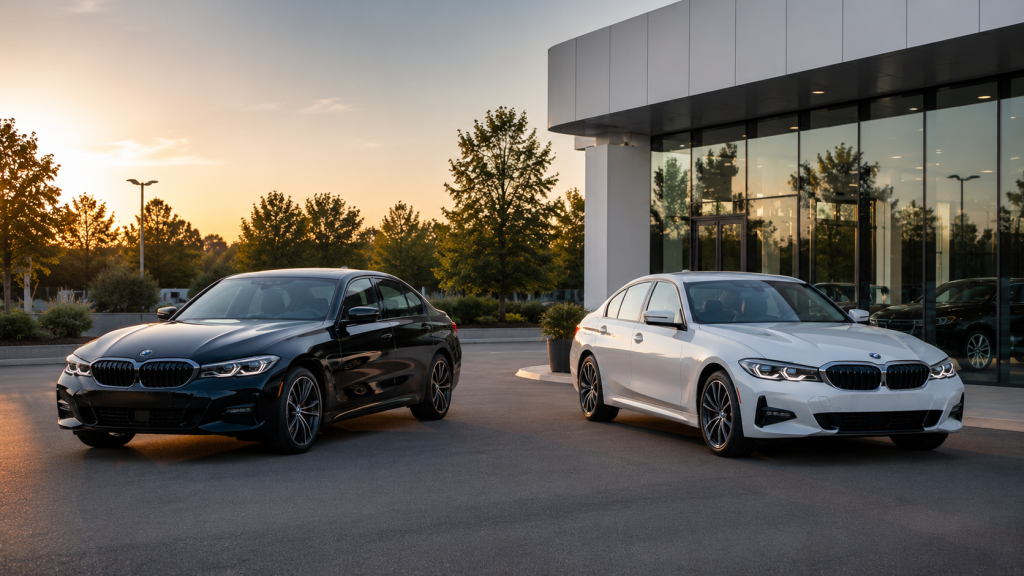
BMW 3 Series lease vs finance comparisons usually begin with monthly payments, but the larger difference comes from how each option handles depreciation, ownership, mileage, and long-term vehicle cost. Both financing and leasing create very different ownership structures even when the same BMW sedan is involved. One path prioritizes lower short-term payments and shorter ownership cycles. The other builds equity while extending ownership length beyond the factory warranty window. Understanding how these structures work helps shoppers evaluate which option fits their driving habits, commuting distance, technology priorities, and long-term financial plans more naturally.
Why BMW 3 Series Lease Payments Usually Cost Less Per Month
BMW lease payments are usually lower because the lease contract only finances the portion of the vehicle expected to depreciate during the lease term. Instead of paying toward the entire vehicle value, the customer pays for projected depreciation plus interest and fees during the lease window.
Residual value plays a major role in this structure. Residual value is the projected worth of the BMW 3 Series at the end of the lease term. Since BMW sedans maintain relatively strong projected resale positioning, the amount financed during the lease can remain smaller than a traditional purchase loan.
A finance contract works differently. Financing covers the full negotiated vehicle price along with taxes, fees, and interest across the loan term. Because the entire vehicle value becomes financed, monthly payments usually rise higher than lease payments for the same BMW model.
BMW lease structures commonly include:
Read the rest of this entry »What Out the Door Price Means at a BMW Dealer
Out the door price meaning becomes much clearer once buyers understand how taxes, registration, financing structure, dealership fees, and optional products combine into the final purchase agreement total. Many vehicle shoppers first encounter pricing confusion after seeing an advertised BMW price online, then noticing the final transaction amount changes during the purchase process. That difference does not automatically come from hidden pricing. Vehicle transactions contain multiple pricing layers that extend beyond MSRP alone. Understanding how those components work together helps buyers review dealership paperwork with greater clarity before signing final purchase documents.

MSRP Is Only One Part of Final Vehicle Pricing
MSRP represents the manufacturer’s suggested retail price before taxes, registration, state fees, financing, and dealership processing costs are applied. Advertised pricing usually reflects the vehicle itself rather than the completed transaction structure.
Once a buyer moves forward with a purchase, additional costs begin layering into the agreement. State sales tax calculations apply based on local tax law. Registration and title processing charges are added through state motor vehicle agencies. Dealership documentation fees cover contract preparation, filing procedures, title transfer processing, and transaction administration.
These categories create the out the door total buyers see before finalizing paperwork.
The final transaction amount commonly includes:
Read the rest of this entry »BMW Extended Warranty vs Third Party Coverage
BMW extended warranty vs third party coverage discussions usually focus on pricing, though the larger differences appear during repair approval, diagnostics, labor reimbursement, and dealership service processing. Modern BMW models rely heavily on integrated electronics, driver assistance technology, sensors, cooling modules, and communication systems that create more repair complexity once factory coverage expires. Because of that, ownership protection involves much more than selecting the cheapest plan available. Understanding how factory backed coverage and outside warranty providers process repairs helps BMW owners evaluate which option creates fewer repair complications during long term ownership.

BMW Factory Extended Coverage Follows BMW Service Workflow
BMW factory backed extended coverage operates through the same dealership repair structure used during the original factory warranty period. Once a covered repair concern is diagnosed, the dealership communicates directly with BMW claim systems for repair authorization, labor allocation, and approved parts replacement.
That process changes ownership flow substantially because BMW technicians already understand the coverage structure, labor procedures, and approved repair categories tied to BMW protection plans. Diagnostics, repair documentation, labor times, and component approvals remain integrated inside the dealership workflow.
BMW factory extended warranty plans usually cover major repair categories tied to:
Read the rest of this entry »Connect with us


