


The BMW maintenance plan that comes with every new vehicle is called Ultimate Care, and it covers factory-scheduled services for the first 3 years or 36,000 miles. Most shoppers know the name but not the mechanics behind it. Understanding how the program is structured, what the Condition Based Service system does, and how Ultimate Care differs from Ultimate Care+ gives you a clearer picture of what you are actually getting. Moreover, knowing what decisions must be made before you leave the dealership protects you from missing options that cannot be added later.
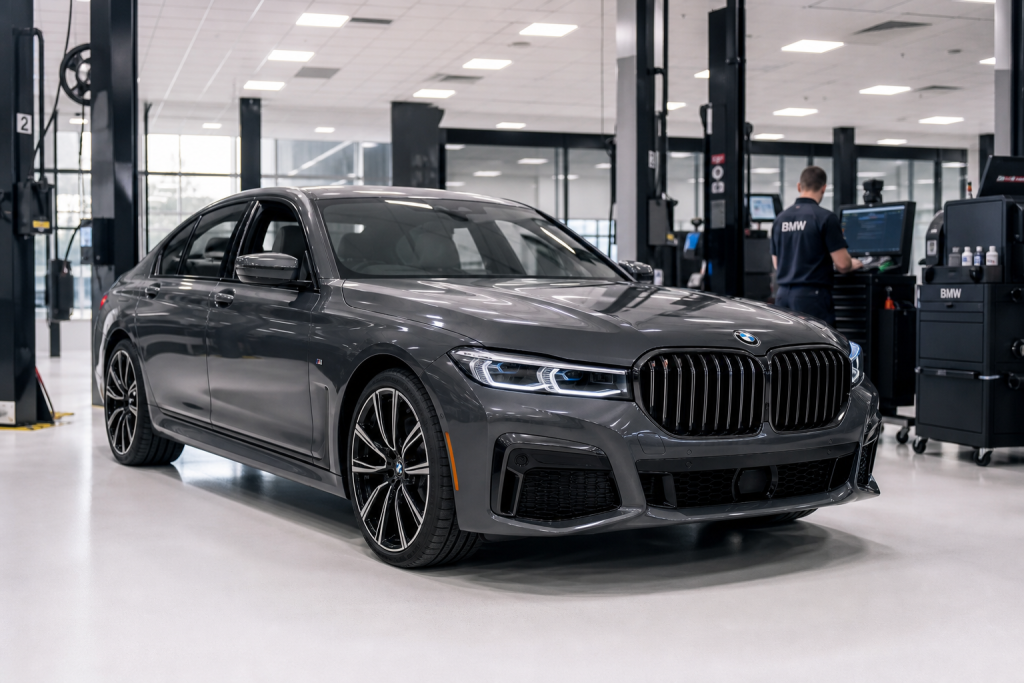
How BMW Ultimate Care Works and What It Covers
Every new BMW includes Ultimate Care at no additional cost. The program covers all factory-scheduled maintenance services for the duration of the coverage window. That includes engine oil and filter changes, brake fluid service, vehicle check services, and remote software updates where applicable. All covered services must be performed at an authorized BMW center using BMW-approved parts and fluids.
The coverage window closes at whichever limit arrives first: 3 years or 36,000 miles. A driver who reaches 36,000 miles in 18 months exhausts the program at that point. A driver who keeps annual mileage low will hit the 3-year calendar limit before reaching the mileage cap. Knowing which boundary applies to your driving pattern matters because it shapes how much remaining coverage you carry into any extension decision.
BMW does not trigger services through fixed mileage intervals under this program. Instead, the Condition Based Service system monitors vehicle data continuously and calculates when each service is actually needed. This is why two owners driving identical models can receive oil change alerts at different mileage points. The interval reflects actual vehicle state, not a number on a sticker.
Condition Based Service: The System Behind the Schedule
Condition Based Service is a sensor-driven monitoring system built into every BMW. It tracks multiple vehicle parameters simultaneously, including engine oil quality, brake fluid moisture content, air filter load, and microfilter condition. Each parameter feeds into a separate service counter that calculates remaining life as a percentage. Additionally, the system alerts the driver when a threshold approaches so service can be scheduled before a condition deteriorates.
How CBS Calculates Oil Life
Oil life calculation under CBS goes beyond simple mileage counting. The system evaluates oil temperature cycles, engine load history, cold start frequency, and short-trip accumulation. A vehicle used primarily for highway driving at steady throttle will carry healthier oil longer than one used for repeated short urban trips, even at identical mileage. As a result, CBS-driven oil change intervals on BMWs frequently extend beyond 10,000 miles and can reach up to 15,000 miles under favorable conditions.
How CBS Monitors Brake Fluid
Brake fluid monitoring works differently from oil tracking. CBS measures the moisture absorption level of the fluid rather than mileage or calendar date alone. Brake fluid absorbs water through the hydraulic system, which lowers its boiling point and reduces stopping reliability under heavy use. When CBS detects that moisture content crosses a threshold, it flags a brake fluid service regardless of mileage traveled. This approach reflects how BMW calibrates service needs to actual vehicle state rather than fixed-schedule assumptions.
Ultimate Care vs. Ultimate Care+: What Actually Separates Them
BMW includes Ultimate Care with every new vehicle purchase, requiring no decision at the point of sale. Ultimate Care+ is a separate, optional program that extends and expands coverage beyond the base plan. However, a buyer must purchase Ultimate Care+ at the time of vehicle acquisition. After taking delivery without adding it, that window closes permanently.
The most significant coverage difference between the two programs is wear-and-tear item inclusion. Base Ultimate Care covers scheduled maintenance services only. Ultimate Care+, by contrast, adds coverage for items that wear through normal use, including front and rear brake pads, brake discs, wiper blade inserts, belts, and clutch linings on manual transmission vehicles. BMW’s new vehicle limited warranty does not cover these items. They are, however, among the most common service costs an owner encounters in years two through five of ownership.
Ultimate Care+ runs across four extension tiers, each defined by a cumulative mileage window that begins where base Ultimate Care ends:
- Ultimate Care+1 extends coverage an additional 12 months, adding wear-and-tear item coverage alongside continued scheduled maintenance up to 14,000 miles beyond the base plan endpoint
- Ultimate Care+2 covers 24 months and extends the program to 39,000 miles beyond base coverage, including both scheduled maintenance and wear-and-tear items throughout
- Ultimate Care+3 runs 36 months and extends to 64,000 miles beyond the base endpoint, maintaining the same dual coverage structure across a longer ownership window
- Ultimate Care+4 provides the broadest extension at 48 months, covering scheduled maintenance and wear-and-tear items to 89,000 miles beyond where base Ultimate Care concludes
The right tier depends on expected ownership length and annual mileage. A driver who keeps vehicles for five or six years and covers 15,000 miles annually will exhaust base Ultimate Care early. Without an extension, several years of out-of-pocket service costs follow.
What Does Ultimate Care Actually Exclude?
Understanding what the program does not cover is as important as knowing what it does. Base Ultimate Care is a scheduled maintenance program, not a comprehensive service contract. BMW schedules what it covers. Wear, breakage, and consumption outside those scheduled intervals fall to the owner.
Tires are excluded from both Ultimate Care and Ultimate Care+. Tire wear varies too significantly based on driving habits, road surface, and load to incorporate into a fixed program structure. Batteries also fall outside coverage, including both the main drive battery on electric models and the 12-volt auxiliary battery on all vehicles. Furthermore, fluid top-offs between scheduled services, including coolant, windshield washer fluid, and power steering fluid, are excluded entirely.
- Tires, wheels, and wheel alignments are not covered under any tier of Ultimate Care or Ultimate Care+, and BMW treats tire wear as an owner-managed consumable cost
- The 12-volt auxiliary battery and, on electric models, the high-voltage drive battery fall outside program coverage regardless of which Ultimate Care tier is active
- Fluid top-offs between scheduled service intervals are the owner’s responsibility and BMW does not reimburse them under either the base program or any Ultimate Care+ extension
Damage from accidents, misuse, or environmental factors also falls outside the scope of this program. BMW’s new vehicle limited warranty addresses manufacturing defects. Auto insurance covers external damage. Shoppers who understand the boundary between scheduled maintenance, wear-and-tear coverage, and warranty protection can evaluate each layer of their BMW’s coverage accurately.
Is Extending Your Coverage Worth It?
The value calculation for Ultimate Care+ comes down to two numbers: what the extension costs at acquisition and what covered services would cost out of pocket at an authorized BMW center. A single brake pad and disc service on a BMW can run between $400 and $700 per axle depending on the model. Brake fluid service typically runs $150 to $250. Furthermore, an oil and filter service at a BMW dealer averages $150 to $200 per visit.
Drivers who keep their vehicles beyond 36,000 miles and plan to use authorized BMW service will face those costs without an extension. Ultimate Care+ consolidates them into a single prepaid amount at acquisition. It also locks in current labor and parts pricing rather than paying rates that may increase across the ownership period. For higher-mileage drivers, that math frequently favors the extension. For drivers who trade vehicles before 50,000 miles, the decision is tighter and depends on which wear-and-tear items would realistically be needed within that window.
Transferability is also worth evaluating at the point of purchase. For BMW vehicles from the 2022 model year forward, Ultimate Care coverage transfers to a subsequent owner. That transferability adds a verifiable service history component to the vehicle’s resale profile. Ultimate Care+ carries separate transferability terms and transfers independently of the base program. Shoppers who prioritize resale positioning benefit from documented, dealer-performed maintenance under a transferable program.
The team at Tom Bush BMW can walk you through which Ultimate Care+ tier aligns with your expected mileage and ownership timeline before your acquisition window closes. For Orange Park drivers who want full visibility into their BMW’s service structure from day one, that conversation is worth having before delivery.
Connect with us


