


The BMW 2 Series vs Audi A3 decision puts two compact German sedans at the same starting price but on very different mechanical paths. Both carry base MSRPs around $41,350, yet the engineering priorities behind each car diverge quickly once you move past the window sticker. One prioritizes driver engagement and powertrain output. The other leads with standard all-wheel drive and a mature technology interface. Understanding what separates them at the platform level gives you a clearer picture of which one actually fits how you drive.
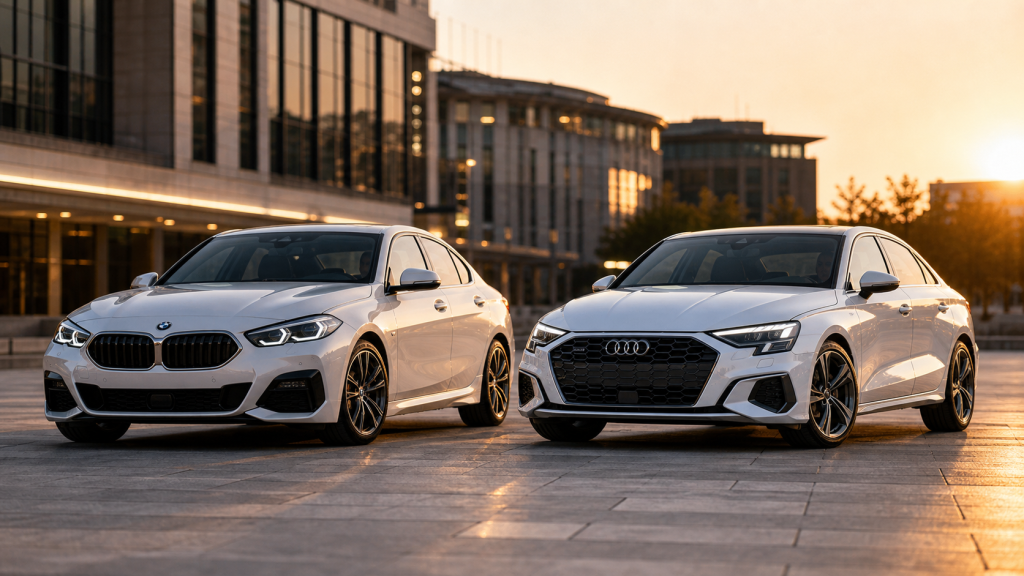
Engine Output and How Power Delivery Actually Differs
Horsepower numbers tell part of the story, but they rarely tell the whole one. The base BMW 228i Gran Coupe produces 241 horsepower, while the base Audi A3 40 TFSI generates 201 horsepower. That 40-horsepower gap looks significant on paper. However, what shapes how each car feels in motion is not peak output alone. It is where torque arrives, how quickly the turbocharger spools, and how the transmission responds when you ask for power.
The 228i pairs its turbocharged 2.0-liter four-cylinder with a 7-speed dual-clutch transmission. Dual-clutch units pre-select the next gear before the shift executes, which produces faster, more mechanical gear changes than a traditional torque converter automatic. The result is sharper throttle response, particularly during mid-range pulls between 2,000 and 4,500 RPM where the engine delivers peak torque. The Audi A3 uses a 7-speed dual-clutch as well, but its lower torque ceiling means the engine needs to rev further to sustain acceleration momentum.
For shoppers asking which car feels faster at a highway merge or through a climbing on-ramp, the 228i holds a clear edge in raw response. Furthermore, the M240i xDrive steps that output to 306 horsepower, widening the gap considerably against Audi’s standard A3 lineup. The performance calculus only shifts when the Audi S3 enters the conversation, which is addressed later.
Drivetrain Configuration: What FWD vs. AWD Means at the Platform Level
One of the most overlooked facts in this comparison is that the base BMW 228i Gran Coupe uses a front-wheel drive platform. That surprises many shoppers who associate the BMW badge with rear-wheel drive dynamics. By contrast, the Audi A3 comes standard with Audi’s quattro all-wheel drive system across its lineup. These are not equivalent configurations, and understanding what each means mechanically changes how you should evaluate them.
Front-wheel drive sends engine torque through the same axle that steers the car. At the base trim level, the 228i manages this well, and BMW’s suspension tuning partially compensates for the front-drive layout. However, when power demand increases, front-drive platforms can exhibit understeer under hard acceleration. The Audi’s standard quattro distributes torque between the front and rear axles continuously, which gives the A3 a more neutral handling posture at the base trim.
The BMW xDrive all-wheel drive system becomes available on higher trims, including the M235i xDrive. xDrive uses an electronically controlled multi-plate clutch to vary torque distribution between axles based on wheel slip, steering angle, and throttle input. So the drivetrain story for BMW is not that it lacks all-wheel drive. Rather, the question is whether you are comparing base trims or stepping into the xDrive lineup. Shoppers prioritizing AWD from the entry price point will find the A3 delivers it without moving up a trim level.
Technology Interface: BMW iDrive vs. Audi MMI
Both manufacturers have invested heavily in their infotainment architecture, and the interface philosophies reflect their broader brand positioning. The BMW 2 Series Gran Coupe carries the iDrive 8 system with a curved dual-screen display that spans the dashboard. The 10.25-inch instrument cluster and 10.7-inch infotainment screen share a single curved glass panel, which creates a visually unified cockpit. Menu navigation runs through a combination of touchscreen input and steering wheel controls.
The Audi A3 uses the MMI touch system, anchored by a 10.1-inch central display and a lower climate control touchscreen. Audi’s layout separates vehicle functions across two physical screen zones, which means climate adjustments do not require navigating through the primary media menu. That structure reduces input steps for frequent adjustments. Beyond that, the A3 retains some physical shortcut buttons along the lower fascia that allow quick access to home and back functions without full touchscreen commitment.
- BMW iDrive 8 integrates navigation, media, and vehicle settings into one curved display panel with gesture control available as an option
- Audi MMI separates climate from media through a dedicated lower touchscreen, reducing menu depth for temperature and fan adjustments
- Both systems support wireless Apple CarPlay and Android Auto, but BMW’s interface responds more quickly to touch input according to multiple independent evaluations
For shoppers who spend significant time interacting with their car’s technology while driving, the choice between these two systems reflects a real preference difference. BMW’s curved display creates a more immersive, driver-forward cockpit. Audi’s split-screen approach prioritizes function separation and reduced distraction for climate inputs.
Performance Trims: M235i xDrive vs. Audi S3
When the conversation moves to performance variants, both brands field compelling entries. The BMW M235i xDrive produces 306 horsepower from its turbocharged 2.0-liter four-cylinder. The Audi S3 counters with 328 horsepower from its own turbocharged 2.0-liter unit. The S3 holds the output advantage at this tier, but output is only one layer of what separates these two cars.
The M235i xDrive carries M Sport suspension tuning, which includes stiffer spring rates and revised damper calibration relative to the standard 228i. The xDrive system in the M235i is also calibrated differently than the base AWD setup, with a rear-biased torque distribution that allows the car to rotate more freely through corners before xDrive redistributes grip. This gives the M235i a handling character that feels closer to a traditional rear-drive BMW than the front-biased base trim suggests. The Audi S3’s quattro system, by contrast, defaults to a front-forward torque split and redistributes power rearward under oversteer detection. The result is a more stable, planted feel rather than a rotationally adjustable one.
Additionally, the M235i benefits from BMW’s M Sport brake package availability, larger front calipers, and a more aggressive steering ratio. Shoppers drawn to the performance tier who want a car that rewards active input will find the M235i’s rear-biased xDrive tuning more engaging. Those who prioritize stability and composed high-speed confidence at the performance level will find the S3’s quattro behavior more reassuring.
What Does Five-Year Ownership Actually Cost for Each Car?
The price parity at the base trim makes this question more important than it might initially appear. According to Edmunds TCO data, the Audi A3 carries a five-year total cost of ownership of approximately $49,313. The BMW 2 Series comes in at approximately $55,345 over the same period. That $6,032 gap does not stem from fuel costs alone.
Maintenance accounts for a significant portion of the divergence. Over five years, BMW maintenance costs are estimated at $6,785 compared to $4,868 for the Audi A3. BMW’s service intervals, parts pricing, and labor rates at authorized dealers drive that differential. Depreciation also favors the A3 slightly, with the BMW losing more value over the same ownership window.
- BMW 2 Series five-year depreciation is estimated at $20,354, while the Audi A3 loses approximately $18,383 over the same period
- Maintenance cost difference over five years runs approximately $1,917 higher for the BMW, with dealer service rates and parts pricing as primary contributors
- Fuel costs remain comparable between the two given their similar engine displacement and EPA-rated efficiency
However, the BMW’s higher performance output and more powerful base engine mean the car delivers more capability per ownership dollar in terms of driving engagement. The question is not simply which costs less. It is whether the additional cost of BMW ownership translates into a driving experience that justifies the gap for your specific use. Shoppers who cover high annual mileage and prioritize ownership economy will find the A3 a more cost-controlled path. Those who weight driver involvement and powertrain response above long-term savings will find the BMW’s premium defensible.
Which Direction Fits the Way You Drive?
These two cars serve the same segment, but the BMW 2 Series Gran Coupe brings a more complete performance package to the comparison. The powertrain advantage starts at the base trim with 40 more horsepower than the A3, and it compounds from there. The M235i xDrive’s rear-biased torque distribution, M Sport suspension tuning, and more aggressive steering ratio give it a handling character that the S3’s stability-forward quattro calibration does not replicate.
The iDrive 8 curved display also sets a higher standard for cockpit immersion and interface responsiveness than the MMI layout delivers. For shoppers who spend time in their car and care about how the driving environment feels, that distinction carries real weight. The A3 offers standard AWD at the entry price point, and its five-year maintenance cost runs lower. However, those advantages come at the cost of output, chassis engagement, and a technology experience that BMW executes more convincingly.
Shoppers cross-shopping this segment because they want a compact that actually drives like a premium car will find the 2 Series answers that question more directly. The Audi A3 is a capable, well-rounded entry. The BMW is the one that reminds you why you wanted a performance compact in the first place. For shoppers in the Orange Park area ready to experience the 2 Series firsthand, Tom Bush BMW offers the full lineup with knowledgeable staff who can walk you through every trim and configuration.
Connect with us


